

 اضغط للتكبير
PEPTIDOLOGY L-Glutathione 1500 mg is a high-purity glutathione material supplied exclusively for controlled laboratory research. Glutathione is a naturally occurring tripeptide composed of glutamate, cysteine and glycine, and is widely studied in cellular redox biology, thiol metabolism and antioxidant-system investigations.
- Defined Research Amount: Listed with a total quantity of 1500 mg.
- Tripeptide Research Compound: Glutathione consists of glutamate, cysteine and glycine.
- Redox-Biology Relevance: Suitable for appropriately designed investigations of GSH/GSSG balance.
- Analytical Purity: Supplier-declared 99% purity by HPLC.
- Research Identification: Product reference 01-043-PD.
- Strictly Non-Clinical: Labeled for research use only and not for human or veterinary use.
لمحة سريعة
الوصف
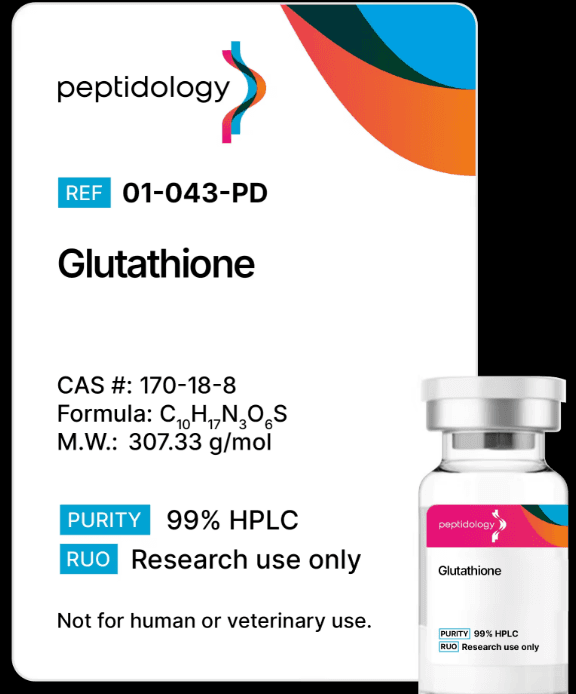
PEPTIDOLOGY L-Glutathione 1500 mg is a glutathione research material supplied in a labeled vial for controlled professional laboratory use. The product title identifies a total quantity of 1500 mg, while the displayed label states 99% HPLC purity and clearly classifies the material as “Research use only” and “Not for human or veterinary use.”
Glutathione, commonly abbreviated as GSH when referring to its reduced form, is an endogenous tripeptide composed of glutamate, cysteine and glycine. It is an important subject in biochemistry because of its involvement in cellular thiol status, oxidation-reduction reactions, enzymatic antioxidant systems, conjugation reactions and maintenance of intracellular redox balance.
Important product distinction: This PEPTIDOLOGY vial is not presented as an oral glutathione supplement, cosmetic preparation or approved sterile medicine. The product page does not establish pharmaceutical manufacturing, sterility, bacterial-endotoxin testing, a route of administration or suitability for human use.
Glutathione in Laboratory Research
GSH/GSSG Redox System: Reduced glutathione, or GSH, can be oxidized to glutathione disulfide, commonly abbreviated as GSSG. The relationship between these forms is widely examined as part of cellular redox-state investigations.
Thiol-Based Biochemistry: The cysteine component of glutathione contains a reactive thiol group. This chemical feature makes glutathione relevant to investigations involving thiol-disulfide exchange, protein glutathionylation and responses to oxidative conditions.
Enzyme-System Research: Glutathione participates in several enzyme-mediated processes. Common areas of investigation include glutathione peroxidase, glutathione reductase and glutathione S-transferase systems, depending on the selected biological model and research endpoint.
Cellular Metabolism: Researchers also study glutathione synthesis, utilization, recycling, compartmentalization and depletion in cellular and biochemical models. Results depend on specimen type, preparation method, assay design, pH, oxidation exposure and analytical controls.
Research Limitations: The established biological role of naturally occurring glutathione does not prove that an external research vial is safe, effective, sterile or appropriate for clinical administration. Biological function and finished-product quality are separate considerations.
Key Research Features
- Glutathione Research Material: Relevant to cellular redox and thiol-system investigations.
- 1500 mg Total Amount: Provides a stated quantity for laboratory inventory planning.
- Tripeptide Structure: Composed of glutamate, cysteine and glycine.
- HPLC Purity Claim: The product label states 99% purity by HPLC.
- Defined Product Reference: Label reference number 01-043-PD.
- Laboratory Classification: Explicitly labeled for research use only.
- Non-Clinical Restriction: The label states that it is not for human or veterinary use.
Browse additional glutathione products and research materials.
Product Specifications
Identity and Quality Verification
The molecular formula and molecular weight shown on the PEPTIDOLOGY label are consistent with reduced glutathione. However, the displayed CAS number contains an apparent discrepancy: the image shows 170-18-8, whereas 70-18-8 is the commonly referenced CAS number for reduced glutathione.
Researchers should not silently correct or ignore this difference. Before using the material in an experiment, request the batch-specific certificate of analysis and confirm the compound name, CAS number, molecular formula, molecular mass, chromatographic identity, purity and reference standard.
A 99% HPLC purity statement does not establish sterility, endotoxin limits, bioburden, residual solvents, water content, oxidation state or the proportion of reduced versus oxidized glutathione. Additional testing may be necessary depending on the experimental application.
Research Handling and Storage
Receiving InspectionDocument the product name, reference number, stated quantity, container condition, batch number and any temperature information supplied with the shipment. Match the certificate of analysis to the exact batch received.
StorageThe Egypt Vitamins product page and visible PEPTIDOLOGY label do not state storage conditions. Follow the supplier’s batch-specific documentation and the validated stability requirements of the laboratory protocol. Protect the material from uncontrolled heat, moisture, light and oxidation where required by the verified specification.
Laboratory HandlingHandle only in an appropriate research environment using suitable personal protective equipment, calibrated instruments and approved laboratory procedures. Prevent inhalation, ingestion, skin exposure, contamination and unintended oxidation.
Experimental PreparationNo human dosage, dilution, reconstitution, injection, infusion, compounding or self-experimentation instructions are provided or implied. Laboratory preparation must follow validated methods, verified supplier documentation and an approved institutional protocol.
DisposalDispose of unused material and contaminated laboratory consumables in accordance with institutional procedures and applicable chemical or biological waste regulations. Do not dispose of the material through household waste or drains.
Frequently Asked Questions
What is glutathione?Glutathione is a naturally occurring tripeptide composed of glutamate, cysteine and glycine. It is widely studied as part of cellular thiol and redox systems.
What does the 1500 mg value mean?It is the stated total quantity of L-Glutathione associated with the research vial. It is not a human dose or recommendation.
Is this an oral glutathione supplement?No. The displayed label classifies it as research-use-only material and states that it is not for human or veterinary use.
Is the material lyophilized?The product is shown in a vial, but the visible label and product page do not explicitly state its physical form. Lyophilization should not be claimed without supplier documentation.
Why is the CAS number flagged?The displayed label shows 170-18-8, while reduced glutathione is commonly referenced under CAS 70-18-8. The certificate of analysis should be checked to determine whether the label contains a typographical error.
Does 99% HPLC purity prove that the product is sterile?No. HPLC purity does not establish sterility, bacterial-endotoxin limits, bioburden or suitability for injection or infusion.
Can this vial be injected or used in an infusion?No such use is supported by the product classification. FDA has documented serious adverse events and endotoxin-related concerns involving improperly sourced or compounded injectable glutathione. This research vial must not be treated as a sterile injectable medicine.
Can this product be promoted for skin whitening?No. The material is labeled for research only, and no cosmetic or therapeutic use is established by the product page. Research into glutathione biology does not justify a skin-whitening claim for this vial.
Research-use notice: For controlled laboratory research only. Not a dietary supplement, medicine or cosmetic product. Not intended for human or veterinary consumption, injection, infusion, diagnosis, treatment, cure or disease prevention.
يُرجى الملاحظة
هام: قد تُغيّر الجهات المصنّعة شكل المنتج أو تركيبته أو ملصقه في أي وقت ودون إشعار مسبق. التفاصيل الموضّحة في هذه الصفحة للاسترشاد فقط، وقد يختلف المنتج الذي تستلمه عمّا هو معروض هنا. ونحن نضمن أن تستلم نفس المنتج الذي قصدت طلبه، وأن يكون أصليًا — مورَّدًا مباشرةً من الجهة المصنّعة أو أحد وكلائها المعتمدين أو موزّعيها الرسميين. اقرأ دائمًا الملصق الموجود على المنتج الذي تستلمه قبل الاستخدام.
أسئلة وأجوبة
لا توجد أسئلة بعد — اسأل أول سؤال وسيجيبك صيادلتنا.
المراجعات
لا توجد مراجعات بعد — كن أول من يراجع هذا المنتج.